

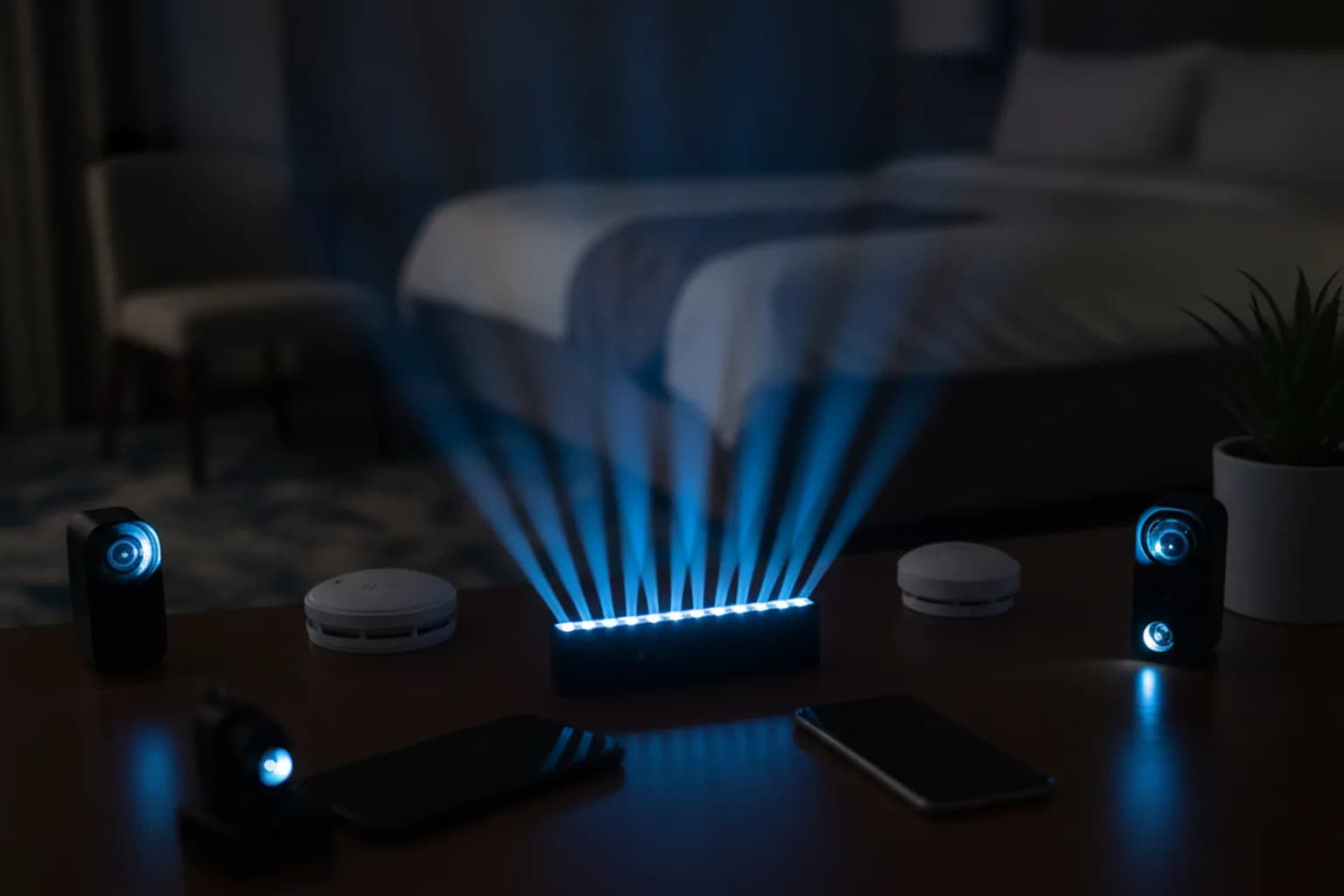
In short: Researchers from KAIST (South Korea) and Singapore University of Technology and Design have built SweepLED — a $7 smartphone clip-on that detects hidden cameras in under five seconds with 93–95% accuracy. Presented at ACM MobiSys 2026 in June, the prototype is ready for commercial manufacturing and could reach travelers worldwide soon.
What SweepLED Is and Why It Matters
Hidden cameras in rental apartments and hotel rooms are not an urban legend — thousands of documented incidents are reported worldwide each year. Cameras are concealed inside smoke detectors, alarm clocks, USB chargers, photo frames, and ventilation grilles. Spotting them with the naked eye is nearly impossible.
Existing solutions — professional RF detectors and specialized LED-equipped glasses — cost $50 or more and require training. SweepLED offers a different approach: a compact smartphone clip-on that any traveler can buy and use without special skills.
The research was announced by EurekAlert on September 1, 2026, and covered in depth by Help Net Security on September 3. The paper was presented on June 20, 2026, at ACM MobiSys 2026, a leading international mobile computing conference.
How the Technology Works: the Physics of Lens Detection
SweepLED exploits an optical phenomenon that distinguishes a camera lens from any other reflective surface — a metal frame, glass, or plastic. A lens produces retroreflection: light hitting it bounces straight back toward the source in a predictable pattern regardless of the angle of incidence. No ordinary surface behaves this way.
The device is a compact platform with 15 directional LEDs that attaches to a smartphone. The detection flow works as follows:
- Scanning. The LEDs illuminate a suspicious object from different angles in sequence. The smartphone stays still.
- Reflection analysis. The onboard algorithm records how reflected light changes as each LED fires. A lens produces a bright spot that follows each LED — a signature sharply different from ordinary glare.
- AI classification. A neural network on the smartphone analyzes the captured frames and delivers a verdict: camera lens or not.
The result: detection in under five seconds, with 93.9% accuracy in hand-held mode and 95.1% when the smartphone is stationary. Component cost is under $7. The researchers confirm that mass production is feasible.
Where Hidden Cameras Are Most Often Found
Based on security researchers and law enforcement reports from multiple countries, the most common hiding spots in hotels and rental accommodations include:
- Bedroom and bathroom: smoke detectors above the bed, pinhole-drilled walls, ventilation grilles, and tinted two-way mirrors.
- Dual-use gadgets: USB chargers, desktop alarm clocks, smart speakers, and picture frames.
- Furniture-mounted: decorative elements on bookshelves, holes drilled through doors and cabinets.
Checking all these locations without dismantling the room is extremely difficult — which is precisely why contactless detection with SweepLED represents a genuine step forward.
What This Means for Your Privacy
Covert recording is not only a humiliating violation of personal space — it is a potential tool for blackmail and fraud. Footage can be used to extort money or distributed without the victim's consent. People often learn what happened far too late, after the material has reached third parties.
Until now, consumers had almost no practical recourse: professional detectors are expensive, and RF scanners miss wired cameras and locally recording devices that emit no wireless signal. SweepLED does not depend on signal type — it searches for a physical lens, not a radio emission.
It is important to understand the distinction: a hidden physical camera threatens your privacy in real-world space, while encrypted traffic protects your data in digital space. Both threats are real and require separate tools. Our security blog covers both types of threats so you can build a layered defense.
How to Protect Yourself Right Now
While SweepLED is not yet commercially available, use these accessible methods:
- Infrared test with your smartphone. Many front cameras lack an IR filter. Turn off the lights and point the front camera into dark corners — cheap night-vision cameras glow purple-white on the sensor.
- Network scan. Use an app like Fing to list all devices on the hotel Wi-Fi. Cameras streaming video over Wi-Fi must connect to the network — unnamed or unfamiliar gadgets are worth noting.
- Physical checks. Press the test button on smoke detectors — a real one beeps. Shine a flashlight into USB chargers — a camera lens produces a characteristic glint. Press your finger to a mirror: on a two-way mirror your reflection touches your finger without a gap.
- RF detector. Inexpensive models catch wireless camera signals. Limitation: wired and locally recording cameras emit no signal and will not trigger an RF scan.
For digital privacy, use LiMP VPN when connecting to hotel Wi-Fi and public networks. The service encrypts your traffic so the network operator cannot see what you transmit. Our zero-logs policy means your connection history is never stored.
Sources
- Anti-Malware.ru — Hidden cameras in hotels can now be found by smartphone in five seconds (September 3, 2026)
- Help Net Security — Researchers build a $7 smartphone clip-on that spots hidden cameras (September 3, 2026)
- EurekAlert! — KAIST develops smartphone-based technology to detect hidden cameras (September 1, 2026)